Use case — Australia
TPZ, SRZ, stem diameter —
recorded on the actual plan.
AS 4970-2025 (Protection of trees on development sites) governs how a tree's protection zones get worked out and shown on a development plan in Australia. LogLog's field record already speaks that vocabulary — stem measurement, condition, photo evidence, all pinned to your plan — it just doesn't calculate or draw TPZ/SRZ radii for you. Here's exactly where it helps and where it doesn't, plainly stated.
What already matches AS 4970 practice
Stem diameter is recorded in centimetres, and multi-stem trees are handled as a comma-joined list of individual stem readings — the same underlying field data an AS 4970 assessor needs whether they call the reading DBH or, for multi-stem specimens, work from DSH (diameter at standard height) or DAB (diameter above buttress) conventions instead.
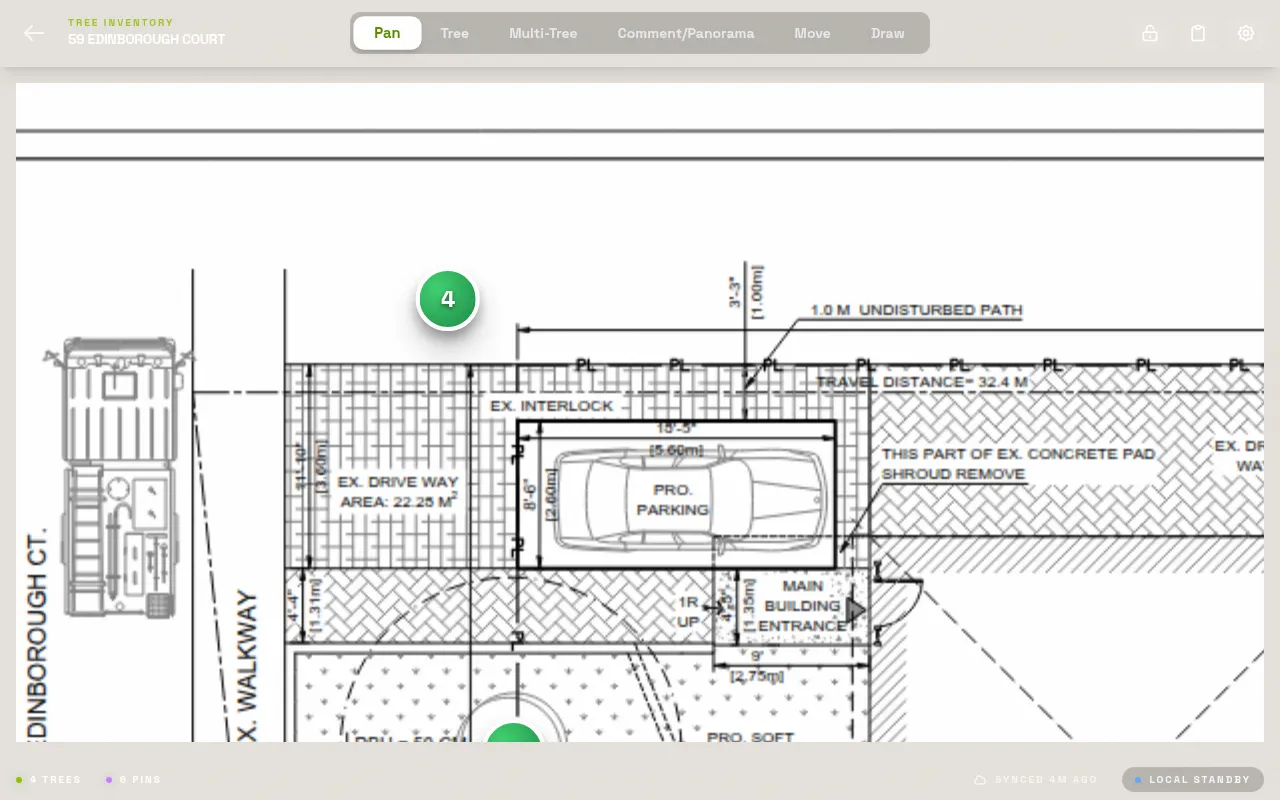
Load the development site plan PDF and pin each tree directly on it, at the position a Project Arborist would reference against the TPZ/SRZ layout. Scale calibration — drawing a known-length line or typing the printed ratio — keeps pin position honest against setback and encroachment measurements a certifier will check.
The zones AS 4970 works with
Tree Protection Zone — the combined above- and below-ground area to be protected during works, calculated from trunk diameter.
SRZStructural Root Zone — the minimum area needed for the tree's structural stability and survival, a smaller radius nested inside the TPZ.
NRZNotional Root Zone — a general-purpose estimate used earlier in design, before a full TPZ/SRZ calculation is warranted.
LogLog does not calculate or draw these radii — the field record it produces (stem diameter, species, condition, position) is what an assessor calculating TPZ/SRZ by hand or in CAD would otherwise be gathering with a tape and a notebook.
DSH vs. DBH — recorded either way
Standard single-stem trees record the same DBH-style stem measurement used worldwide. Multi-stem or buttressed specimens, where an AS 4970 assessment calls for DSH or DAB instead, still fit LogLog's stem field — it's a text field specifically so a non-standard multi-stem reading can be entered as a list rather than forced into a single averaged number.
Export that hands off cleanly
The export ZIP gives a spreadsheet of every field per tree, the annotated plan with pin positions, and photos named by tree number — a solid package to hand to whoever's producing the formal Arborist Report or Tree Protection Plan for the development application.
Where it stops — say this plainly
LogLog does not calculate TPZ, SRZ, or NRZ radii, does not draw protection zone overlays on the plan, and does not export DWG or shapefile output for a CAD technician to open directly. If your workflow depends on auto-generating protection zone circles or feeding stem data straight into AutoCAD or a GIS package, that handoff isn't built yet — the annotated PDF is a clean field reference to work from, not an importable vector file.
Treat LogLog today as the field data capture layer for an AS 4970 tree assessment — species, stem diameter, condition, photos, all pinned to the site plan and exported cleanly — not as a TPZ calculator or a Tree Protection Plan generator.
Photographic evidence, tied to the record
A condition assessment feeding into a development application is more defensible with a photo attached to that specific tree — root plate disturbance, existing decline, structural defects that bear on retention feasibility. LogLog attaches photos directly to the tree record and exports them named by tree number.
Metric throughout, no unit conversion
Stem diameter and other measurements record in centimetres by default — matching Australian practice without a US-first tool's units bolted on top and converted after the fact.
The old way
Notebook and a printed development plan on site, then typing every stem measurement into a spreadsheet afterward and marking up a CAD file separately — time-consuming, and you're still carrying paper to reference tree numbers against the plan.
With LogLog
Stem diameter and condition go straight onto the digital site plan as you walk it. The spreadsheet exists the moment you finish the last tree — no retyping from a notebook that evening.
See the full field record on tree data fields, how pin placement works on PDF site plans, and what an export contains on exports. Working to BS5837 in the UK instead? See BS5837 surveys.
Field capture and zone calculation stay separate jobs
Rather than trying to be the whole pipeline from field tape to a finished Tree Protection Plan, LogLog does one part of it well: getting accurate, structured survey data off the site and into a clean spreadsheet fast. TPZ/SRZ calculation and the formal Arborist Report still belong to whoever's producing them today — LogLog just means they're working from a spreadsheet and an annotated PDF instead of a stack of field notes.
Try it on your next development-site assessment.
Free forever for solo use. Load your site plan and see if the field workflow fits.